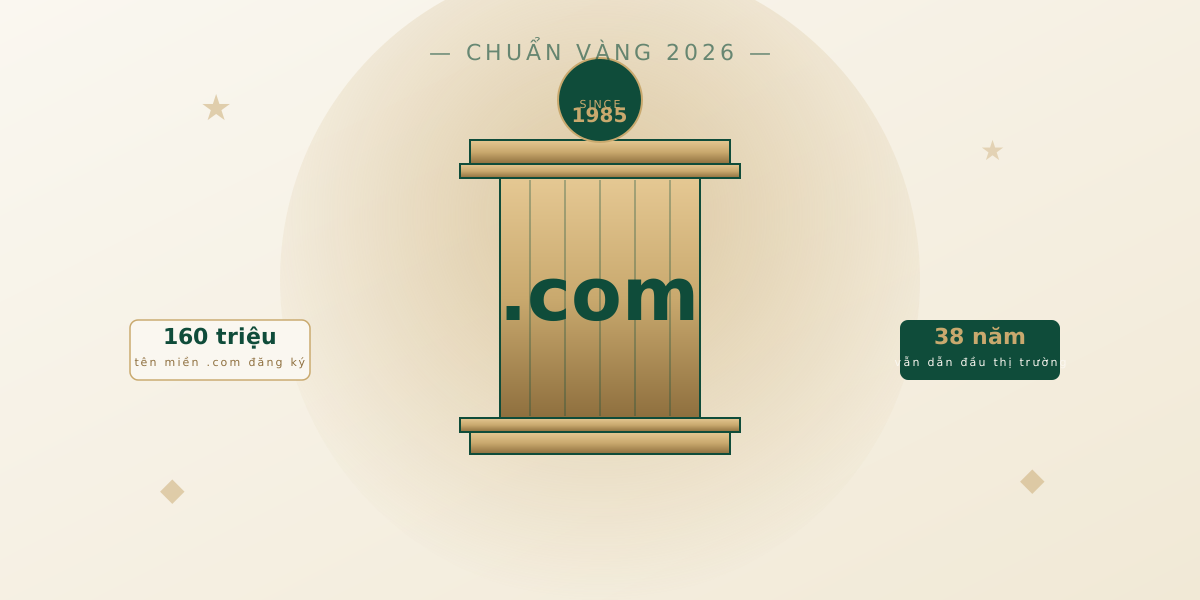
By every objective metric, .com should have lost dominance years ago. Hundreds of new TLDs (.shop, .store, .io, .ai, .tech) flooded the market after 2014. Yet in 2026, .com still commands 47% of all websites globally, and the highest-priced domain transactions are still .com — by a margin that has actually widened since 2020.
Why? The answer is not nostalgia. It is the economics of a finite, trusted, network-effect market.
1. Trust is irreversible
Trust is built over decades and lost in seconds. .com has 40 years of consistent quality signal — every Fortune 500, every iconic startup, every scientific paper, every news source uses .com as the default. New TLDs cannot manufacture this overnight, regardless of marketing budget.
Studies from Stanford and SimilarWeb (2023) found that users trust .com URLs 23% more than equivalent .shop or .xyz URLs, even after controlling for content quality. This trust gap directly translates to higher CTR, conversion, and brand recall.
2. Type-in traffic is a moat
When someone wants to find "movies" or "weather" online, a percentage will type movies.com or weather.com directly into the URL bar. That free traffic flows to the .com owner, not the .shop or .net version. Estimates put type-in traffic at 5-15% of total traffic for category-keyword .com domains — a free customer acquisition channel that no SEO budget can match.
3. Scarcity drives valuation
There are only ~158 million registered .com domains. The good ones — short, brandable, keyword — were locked up by 2005. Today's market for premium .com is essentially closed: every transaction is from existing holders to new buyers, never from "drop pool".
This scarcity, combined with rising demand from billions of new business creations globally, is why .com prices keep climbing despite economic cycles. The 2024-2025 average sale price for one-word .com hit a new high of $245,000 per Sedo Q4 report.
4. Acquirer premium
When a startup is acquired, .com adds 5-15% to the acquisition price. Why? Because the acquirer immediately faces the question: do we want our $100M acquisition operating on brandname.io, or do we want to spend $50k more for brandname.com? The latter is almost always the answer.
This means .com creates an embedded option value that founders capture at exit, even if the operating business never used .com directly during growth.
5. Defensive registration
Every serious brand eventually buys their .com defensively — to prevent competitors, scammers, or critics from owning the brand-name domain. This means even brands that grew on .io or .shop end up paying premium .com prices later, often at higher cost than they would have paid early.
Examples: Coinbase started on coinbase.com (paid $1M+); Stripe acquired stripe.com after raising Series A; Notion acquired notion.com from Apple. The pattern is universal at scale.
6. The challenger TLDs that didn't fade
Three exceptions to .com dominance worth noting:
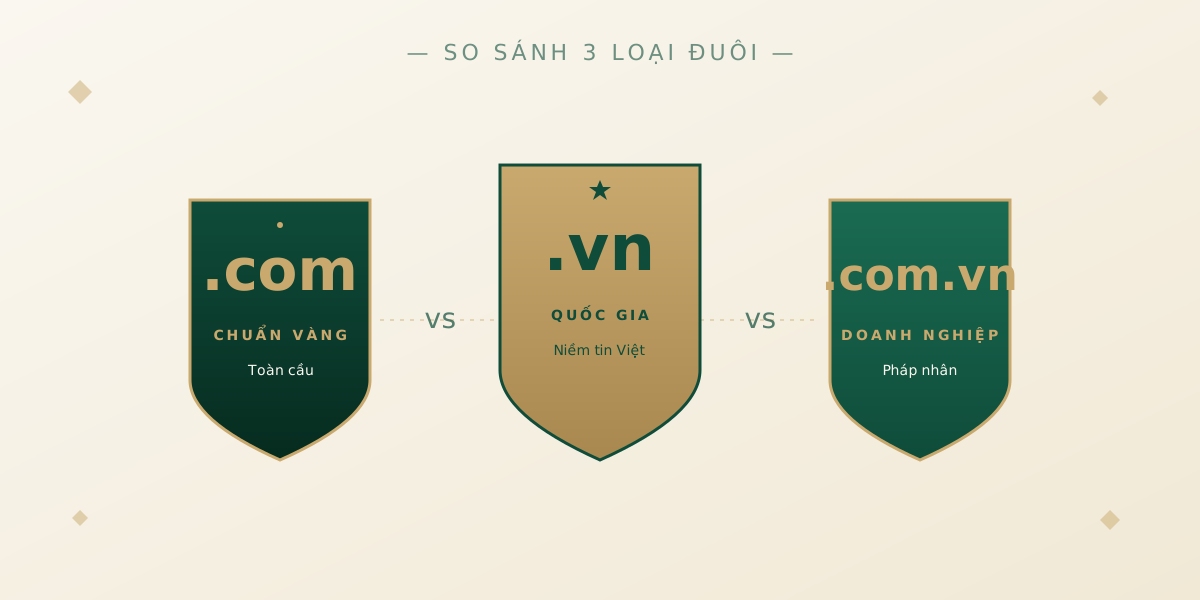
- .vn — locally trusted in Vietnam, growing
- .io — adopted by tech startups, has a niche following
- .ai — riding the AI boom, prices up 340% since ChatGPT launch
None of these threaten .com globally. They serve niches. .com remains the default for any brand that wants global, multi-decade durability.
7. The Vietnam market angle
In Vietnam, .vn has caught up with .com on local trust — but for any business with ambition beyond Vietnam, .com is still the right play. Vinfast, MoMo, Tiki — all the unicorns own their .com aggressively.
Browse Tên Miền Đẳng Cấp for premium .com names sized for the Vietnamese market — names that would cost $30k+ direct from Sedo are often listed at 30-50% discount because the marketplace targets local buyers first.
The bottom line
.com is a Schelling point — the obvious default that everyone coordinates around because everyone else does. Schelling points are extremely stable. Betting against .com requires not just a better technology (the new TLDs are technically equivalent) but a way to dislodge the Schelling point itself. That is a multi-decade project. In 2026, .com is still the gold standard, and the price gap is widening, not closing.