Every year hundreds of "lost domain" cases happen in Vietnam due to sloppy transfer processes: paying before verifying ownership, no contract, using personal email for billion-VND asset transfers. This is the complete handbook — written from the perspective of someone who has executed hundreds of premium domain transactions in the Vietnamese market.
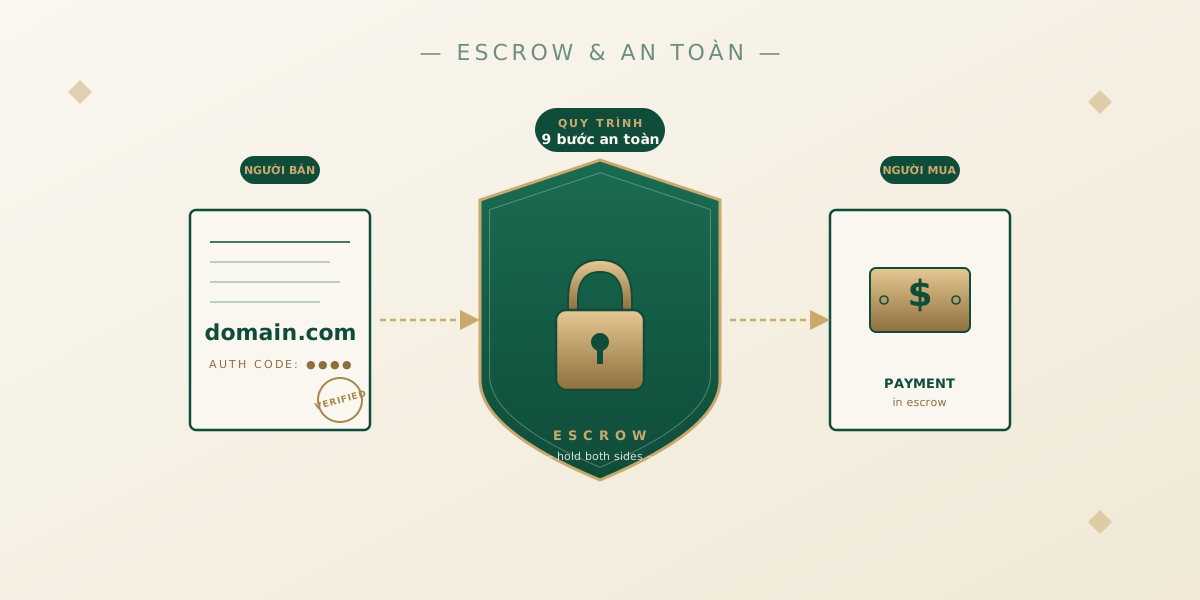
The 9-step safe transfer process
Step 1 — Verify ownership before any payment
The seller's claim is not enough. Verify:
- WHOIS lookup matches the seller's name/company
- Registrar account confirmation (some sellers send a screenshot)
- Domain not in transfer-lock or pending dispute
If WHOIS is private, request the seller to temporarily make it public, OR escrow service can verify on your behalf.
Step 2 — Sign a written transfer contract
Verbal agreements are insufficient. Contract should include:
- Both parties' full legal name and tax ID
- Exact domain being transferred
- Sale price + currency + payment method
- Delivery method (registrar push, transfer, escrow)
- Warranty: domain is unencumbered, no UDRP pending
- Default clauses: refund window, broker fees
For deals over $5k, hire a lawyer for review. Cost ~$200-500 — saves vastly more in disputed transactions.
Step 3 — Use escrow for any deal > $1k
Escrow.com is the global standard. Process: buyer deposits funds in escrow → seller transfers domain → buyer confirms ownership → escrow releases funds.
Escrow fee: 0.89-3.25% depending on amount. Skipping escrow on a $10k+ deal is the most common reason buyers lose money.
Step 4 — Choose a reputable registrar
For .com:
- Tier 1 (recommended): GoDaddy, Namecheap, Cloudflare
- Tier 2 (acceptable): Dynadot, NameSilo
- Avoid: registrars with poor reviews on Trustpilot
For .vn:
- Tier 1: PA Vietnam, Z.com, iNet
- Tier 2: Mat Bao, BKHost
Step 5 — Get the auth/EPP code
For .com transfers between registrars: buyer requires the auth code (also called EPP code or transfer code) from the seller's registrar. Without this, no transfer is possible.
Auth code is a one-time secret. Treat it like a banking password — once disclosed, change immediately after transfer completion.
Step 6 — Initiate the transfer
For .com (between registrars):
- Buyer initiates transfer at their registrar with the auth code
- Seller's registrar emails the seller for transfer authorization
- Seller approves the transfer
- 5-7 days later, transfer completes automatically
For .vn (within Vietnam):
- Use VNNIC's "Đối tượng đăng ký" change form
- Submit signed paperwork from both parties
- VNNIC processes 7-14 business days
Domain "push" (within same registrar):
- Seller pushes the domain to buyer's account at the same registrar
- Instant transfer (vs 5-14 days for inter-registrar)
- Cheapest method — often free
Step 7 — Confirm ownership transfer
After receiving the domain:
- Login to your registrar — confirm the domain is in your account
- Check WHOIS — verify your contact info shows up
- Test DNS — point the domain to a test page, confirm it loads
- Re-generate auth code — invalidate the old one
- Enable transfer-lock — prevents unauthorized future transfers
Only after all 5 confirmations: release funds from escrow.
Step 8 — Update WHOIS and lock the domain
Critical security steps:
- Update WHOIS to your real name + active email
- Enable WHOIS privacy (mask personal info from public)
- Enable two-factor authentication on registrar account
- Set domain to auto-renew
- Buy 5-10 years upfront (locks in current pricing + reduces theft risk)
Step 9 — Document everything
Keep for 5+ years:
- Original transfer contract (signed)
- Email thread with seller (PDF backup)
- Escrow transaction record
- Registrar transfer logs
- Initial DNS configuration
This documentation defends you in any UDRP, trademark dispute, or future resale.
Common pitfalls to avoid
- Wire transfer to seller's personal account — never. Use escrow or business bank accounts only.
- Trusting a "registrar email" without verifying — phishing emails are common. Always login directly to confirm.
- Buying without auth code in hand first — seller might not have it; deal could fall through.
- Using free email for the domain account — if the email is hacked, the domain can be stolen.
- Skipping the trademark check — buying a name with active trademark conflict invites UDRP loss.
When to use a broker
Recommended for:
- Deals over $20k (broker fee is worth the dispute prevention)
- Cross-border transactions (Vietnam buyer + foreign seller)
- When buyer/seller don't share a common language
- When the domain has complex history (penalties, disputes)
Broker fee: 5-15% of transaction value. Reputable brokers: Sedo, Saw.com, MediaOptions for international; Tên Miền Đẳng Cấp for Vietnamese-market specifically.
UDRP and dispute resolution
If a dispute arises:
- Try direct resolution first (usually email or call)
- Escalate to escrow service if used
- For trademark disputes: file UDRP at WIPO (cost ~$1,500, 60-90 days)
- For .vn disputes: VNNIC arbitration (cost lower, 90-120 days)
- Last resort: civil court (expensive, slow)
UDRP success rate for trademark holders: ~85%. UDRP success for non-trademark complaints: very low. Most disputes are settled in step 1 or 2.
The bottom line
The 9-step process feels bureaucratic for small transactions but is essential for any deal over $1k. Skipping steps to save time is the #1 cause of "lost domain" stories in Vietnam. Discipline + escrow + documentation = sleep well at night.
For Vietnamese-market transactions specifically, Tên Miền Đẳng Cấp handles all 9 steps end-to-end with built-in escrow and contract templates — significantly safer than direct seller deals for first-time buyers.